
86 13686388557

Date:2026-09-17
On a Tuesday morning, a small silver robot follows a slow, careful line across a flat suburban lawn. That same afternoon, a tracked remote control lawn mower crosses a 28-degree embankment on the other side of town while the operator remains on flat ground fifty metres away.
These two machines are often placed side by side in catalogues, but they are designed around very different working problems. One is intended to remove a repetitive mowing task from the operator's day. The other is designed to move the operator away from the hazardous part of the job.
One is primarily about autonomous mowing. The other is primarily about keeping the operator out of difficult terrain.
A robotic mower is an autonomous machine. It follows a defined boundary or positioning system, cuts smaller amounts of grass on a regular schedule and returns to its charging station. A remote-controlled mower is a piece of working equipment where the operator remains actively involved while standing at a safer distance from the machine.
The robot answers the question, "Who does the mowing?" The RC mower answers a different question, "Who needs to stand on the slope?"
That difference affects almost every practical part of the purchase: the slope the machine can handle, the ground it can cross, preparation time, operating costs and what happens when the terrain or working conditions change unexpectedly.
A robotic mower makes most operating decisions by itself. Depending on the model, it can use a boundary wire, GPS or RTK positioning, onboard sensors and a programmed schedule. It slows or changes direction when its sensors detect an obstacle, follows its mapped working area and returns to its dock when charging is required.
The operator normally sets the system up and then monitors it periodically. Newer commercial robotic mowers can add RTK positioning and fleet-management software, but the basic operating model remains the same: programme the machine, define the area and let it work within those limits.
A remote-controlled mower works differently. The operator controls the machine in real time, deciding the travel line, speed and when to stop. That direct control becomes particularly useful on a slope, around rocks, beside a guardrail or in rough vegetation where the working conditions can change from one metre to the next.
The machine provides the traction, cutting width and mechanical capability. The operator provides the judgement about where to drive and when the conditions require a change in direction or speed.
Some newer platforms blur the line between the two categories. An autonomous mower may have a remote emergency-stop function, while a remote machine may offer a follow mode or pre-mapped passes.
Those features do not necessarily change the main purpose of the machine. If an operator can take control immediately from a distance and actively manage the machine through hazardous or irregular sections, it is still functioning as an RC mower for those parts of the job.
THE SHORT VERSION: Robot = remove the repetitive mowing task. RC = remove the operator from the hazardous working area. If you remember only one line from this guide, make it that one.
The table uses working, real-world figures rather than brochure peak figures. Robotic mower slope capability varies significantly by model, and the higher figures normally depend on machines with suitable traction systems such as all-wheel drive. Basic residential models can have substantially lower practical limits.
| Factor | Robotic mower | Remote-controlled mower |
|---|---|---|
| Who decides | The onboard software | The operator, in real time |
| Typical slope | 15 to 25 degrees; AWD up to about 35 | 30 to 50 degrees sustained |
| Cutting action | Small rotating discs, little and often | Flail or rotary deck, one heavy pass |
| Ground it handles | Lawn only, no rocks or high weeds | Rough grass, scrub, obstacles |
| Setup | Boundary or GPS map, then daily autonomy | No boundary; operator drives each pass |
| Runtime model | Docks and charges itself | Fuel tank or swappable battery packs |
| Safety model | Sensors plus lift and tilt cut-outs | Loss-of-signal stop plus tilt cut-out |
| Best fleet fit | Flat, repeated, predictable areas | Steep, irregular, one-off work |
| Main weakness | Struggles with high grass and shade | Needs an attentive operator |
The right machine becomes much easier to identify once the actual ground is described. These three examples cover a large part of the practical buying decision.
The flat suburban site: A robotic mower is well suited to this type of work. The lawn is predictable, the slope is gentle, and the value comes from removing a repetitive mowing task. The robot can run on a regular schedule and keep the grass short without an operator pushing or driving the machine through every section.
The steep roadside bank: This is where remote-control equipment becomes relevant. The slope, uneven surface and need to keep the operator away from the face of the bank create a different working requirement. A tracked RC mower with a flail deck is designed for this type of rougher terrain and active operator control.
The solar field with flat zones: A mixed site can benefit from a mixed approach. A robotic mower can handle predictable flat inter-row areas, while an RC machine can be used around perimeter bunds, ditches and other irregular sections. Running two types of equipment is not necessarily a compromise; it can divide the work according to terrain.
MIXED FLEET: Use the robot for ground that can be mowed predictably without continuous operator input. Use the RC machine for ground where the terrain, vegetation or hazards require someone to control the machine from a safe position.
Neither machine is a universal answer. The table below shows the situations where each type starts to become less suitable for the job.
| Situation | Robotic mower | Remote-controlled mower |
|---|---|---|
| Tree cover or shade | GPS and RTK signals can drift or drop | Not affected; operator sees the line |
| Steep slope | Basic models stall; AWD still has a limit | Built for it, within its rating |
| Tall or wet grass | Small discs clog and scalp | Flail deck keeps cutting |
| Large flat lawn | Excellent and economical | Over-specified and costly |
| Operator fatigue | None required | Demands attention for every pass |
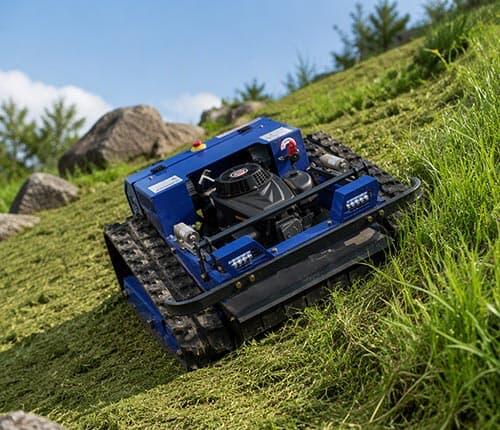
Commercial contractors can have good reasons to operate both types of equipment. Robotic mowers can cover safe, repetitive areas with limited operator involvement, while an RC mower remains available for dangerous, rough or irregular sections that cannot be handled efficiently by autonomous equipment.
The practical advantage is not simply having two different machines. It is dividing the site according to the nature of the work. A flat lawn that repeats the same pattern every week has different equipment requirements from a steep ditch, rough perimeter or one-off overgrown section.
Think of the operation as dividing the site by risk and working conditions rather than by machine preference. Flat and predictable areas can go to the robot. Steep, rough or irregular areas can go to the RC unit.
OPERATING MODEL: Automate the predictable ground and remote-control the difficult ground. Many commercial properties contain both types of terrain.
If the decision is still open, answer these four questions in order:
Is the main mowing area flat, open and predictable? If yes, an autonomous mower is worth considering because the machine can repeatedly follow the same defined working area.
Does the site contain steep slopes, rough vegetation or obstacles? If yes, check whether those areas require direct operator control and whether a tracked RC mower is better suited to them.
Does the grass stay short because the area is mowed frequently, or does it regularly become tall and heavy? Frequent light cutting favours the working model of a robotic mower, while tall or heavy vegetation may require a more substantial cutting deck.
Is the saving measured in labour hours, or in keeping people off a slope? This distinction matters. Autonomous mowing can reduce repetitive operator involvement, while an RC mower can reduce the need for an operator to physically enter a hazardous working area.
If the first answer is “under 20 degrees and mostly flat”, start by evaluating a robotic mower. If the site is “over 25 degrees or rough ground”, start by evaluating remote-control equipment. If the property contains both conditions, a mixed fleet may be the more practical operating model.
A robotic mower is designed to operate autonomously within a defined area, while an RC mower is controlled continuously by an operator from a distance. The difference becomes particularly important when terrain, vegetation or safety conditions require active control.
Some robotic mowers can work on moderate slopes, particularly models with suitable all-wheel drive and traction systems. However, slope capability varies by machine, and the manufacturer's stated limit should be checked against the actual terrain. Steep or irregular slopes require a different level of traction and operator control.
Tracks provide a larger continuous contact area and can maintain contact across uneven ground. Combined with a low centre of gravity and a suitable drive system, this can make a tracked RC mower more appropriate for difficult slopes than a conventional wheeled mower.
Yes. A property can be divided according to terrain and working requirements. A robot can handle flat, repetitive areas while an RC mower deals with steep banks, ditches, rough vegetation or irregular perimeter sections.
It depends on the mower's cutting system, but the working model of a robotic mower is generally based on frequent light cutting rather than taking a heavy amount of tall vegetation in one pass. An RC mower equipped with a flail deck is designed for heavier vegetation and rougher working conditions.
Start with the site rather than the machine category. If most of the area is flat, predictable and regularly maintained, autonomous equipment can be evaluated for that section. If the work includes steep slopes, rough vegetation or areas where an operator should remain away from the machine, an RC mower is worth evaluating. For sites containing both conditions, using both types can be practical.
For a specific property, it is useful to compare the slope, grass height, working area, daily operating hours and access conditions before selecting the machine configuration. You can also contact our team to discuss the working conditions and the appropriate RC mower configuration.
BOTTOM LINE: Remote-controlled mowers and robotic mowers are not simply competing versions of the same machine. They answer different working problems. The robot is suited to predictable ground that can be automated, while the RC mower is suited to terrain where direct control and operator distance matter. A commercial site containing both types of ground may need both.
Get instant pricing, specs, and shipping details from our team.