
86 13686388557

Date:2026-09-16
In early June, a highway crew faces a 28-degree embankment that has not been trimmed since spring. A ride-on mower would put an operator directly into the working area of the slope. A rope-and-harness crew could take the whole day. The practical question is not which remote control lawn mower has the biggest number on the specification sheet. It is which machine will still hold the slope and cut cleanly when the grass is wet and the machine is travelling across the face of the bank.
That distinction between a marketing claim and a machine that can handle the actual working conditions is the whole point of this guide.
Every steep-slope machine comes with a slope rating. The useful ones are normally stated as a sustained working angle under defined conditions, such as firm and dry ground. Other specifications may highlight a short controlled peak angle. Those two numbers describe very different situations, and treating them as the same is where expensive equipment mistakes begin.
The difference between those figures is not a minor specification detail. It can determine whether a machine performs properly during a real mowing route or only looks impressive during a short demonstration. Spending a few minutes understanding the terminology before ordering can prevent a costly mismatch later.
Four terms do most of the work:
Peak angle: the steepest slope the machine can cross once under controlled conditions.
Sustained angle: the slope angle at which the machine is designed to work continuously without excessive overheating, slipping, or lubrication problems.
Side slope (cross slope): the angle while travelling horizontally across the face of the slope. This is generally more demanding than climbing directly uphill.
Wet-grass derating: the reduction in practical traction and usable slope capability once the grass becomes slick. A reduction of five to ten degrees is commonly used as a practical reference, but the actual result depends on the machine, tyres or tracks, grass condition, soil and slope.
Many buyers only discover the difference between peak and sustained performance after the machine reaches a difficult slope. That is why the comparison later in this guide focuses on sustained working angles rather than the highest number that can appear in advertising material.
RULE ONE: Buy for the sustained angle on the worst surface you actually mow. The peak angle is a controlled limit, not a target for the normal working route.
The right machine depends as much on the application as it does on the slope itself. The same hillside can require different machine configurations for different users. A homeowner mowing twice a month has very different priorities from a contractor operating eight hours a day, while a highway crew may plan its equipment around an entire mowing season.
The property owner: One or two steep banks, mowed a few times each season. Priorities include reasonable up-front cost, simple controls, easy storage and a machine that can be started reliably after spending several months in a shed.
The landscaping operator: Several steep properties every week. Priorities include cutting speed, a flail deck capable of handling mixed vegetation, and a service network within a reasonable driving distance.
The municipal or highway crew: Long, exposed embankments handled according to a fixed schedule. Priorities include rollover margin, usable remote-control range, spare parts available with the working equipment, and a documented maintenance interval.
Notice that none of these applications starts with horsepower. The homeowner may care more about storage and starting after seasonal downtime. A contractor may focus on uptime and deck width. A municipal crew may place more weight on operating margin, safety response and parts availability. Those practical requirements should be checked before focusing on the headline horsepower figure.
Six features show up repeatedly on machines intended for serious slope work:
None of these features is exotic. They are simply the details that become increasingly important as the terrain becomes steeper and the working conditions become less predictable. They are also the areas where lower-cost machines can differ substantially from equipment designed for professional slope work. Check them in this order rather than starting with brand, appearance or a single headline specification.
A low centre of gravity, with the engine or battery mounted deep in the chassis.
Tracks rather than wheels for the steepest working conditions. The larger continuous contact area can provide more consistent traction on uneven ground.
A loss-of-signal response that stops the blades and brings the machine to a safe state rather than allowing it to continue driving without operator control.
A tilt or rollover cut-out that stops drive or cutting functions before the machine passes its defined safe operating angle.
A flail deck with float and skid shoes, allowing the cutting system to follow the terrain instead of digging into uneven ground and scalping the surface.
Either a 48- to 60-volt electric platform or a four-stroke engine with an appropriate wet-sump or forced-lubrication system for the intended slope application.
WHERE TO SPEND: Tracks and a low centre of gravity can contribute more to practical slope control than simply adding another ten horsepower. For a steep-hill machine, budget should first cover traction, stability and safety-related hardware before chasing extra engine power.
The table below groups representative machine classes by the type of work they are built for. The ratings shown are sustained working angles on firm, dry ground because that is the figure that has greater practical value when evaluating a regular route. Some categories deliberately overlap. A capable electric tracked unit can fall into a similar angle range to a smaller gas crawler, which is where deck design, weight, working hours and site conditions become important.
This is not a ranked list and it is not a recommendation to purchase a particular brand. It is a way to understand where different machine classes generally sit before narrowing down a shortlist. A mid-range tracked gas mower and a heavy-duty crawler may advertise similar peak angles, while their practical differences appear in machine weight, deck width, traction, safety margin and how the manufacturer defines sustained operation.
Use the table to establish an appropriate budget bracket first, then evaluate the rest of the guide against that requirement. A machine that is significantly over-specified can increase purchase and maintenance costs. A machine that is under-specified can create lost working days, excessive wear and difficult operating conditions.
| Class | Example platform | Sustained angle | Best fit |
|---|---|---|---|
| Heavy-duty tracked | 60–600 kg crawler, 25–40 hp | 45–60° | Highway & municipal embankments |
| Mid-range tracked | 20–35 hp gas crawler | 35–45° | Landscape contractors, large banks |
| Electric tracked | 48–60 V lithium crawler | 40–50° | Low-noise sites, short-cycle routes |
| Compact electric | Walk-behind RC, 1–2 kWh | 25–35° | Homeowners, small steep yards |
| Hybrid / articulated | Crawler front + wheels rear | 40–55° | Mixed terrain, transport sections |
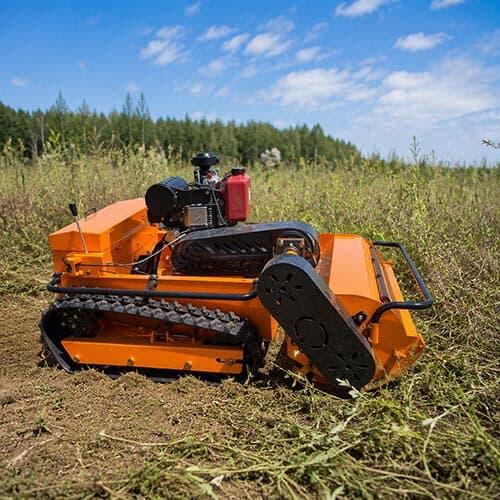
A single slope rating is not enough. Ground cover, water and the distance from the truck can all change the practical answer. A bank that looks almost identical in June and October may behave very differently once the grass becomes wet or the soil underneath has loosened.
Roadside embankment: A heavy-duty tracked platform with a flail deck and a documented sustained-angle rating is generally the appropriate machine class to investigate. The additional machine capability is intended to provide working margin rather than simply increase cutting speed.
Orchard or vineyard: A narrower mid-range tracked machine with suitable canopy clearance and a sealed drivetrain can be more practical between rows, where machine width and access can matter as much as slope angle.
Wet ditch or riverbank: Tracks with deep lugs can provide a more suitable traction system than relying on conventional wheel traction. The practical slope rating should also be reduced according to wet grass and loose-soil conditions.
Solar farm or slag field: Articulated or hybrid platforms can make sense where the working route combines steep terrain with longer flat transport sections.
Private steep yard: A compact electric RC mower can cover a relatively small mowing area with less noise and without on-site fuel storage, provided the slope and working cycle remain within the machine's operating limits.
Before money changes hands, ask the supplier questions that separate a machine designed for regular slope work from one demonstrated only under controlled conditions. Write the answers down and compare them with the actual jobsite.
Is that rating for climbing straight up, or for full cross-slope travel?
What does the angle drop to on wet grass or loose soil?
Where is the tilt cut-out set, and can the operator see it trigger?
What does a set of tracks, rollers, and flail hammers cost, and how long do they last?
Is there a local dealer, or am I ordering parts from overseas?
How long does the battery actually run, end to end, with the blades loaded?
Will the frame fit through the gate or trailer I already own?
The right remote control lawn mower for steep hills in 2026 is not necessarily the machine carrying the tallest number in its marketing material. The practical choice is the machine whose sustained working angle, traction system and safety response match the worst conditions on the actual route, including wet grass and cross-slope travel.
For a homeowner, that may mean a compact electric machine when the property and working cycle suit it. For a contractor, a mid-range tracked flail mower can provide a useful balance between machine size, cutting capability and regular commercial use. For a municipality or highway crew, a heavier tracked platform may be appropriate where longer embankments, greater operating margin, spare parts and service support are required.
The machine should only move up that range when the slope, vegetation, working hours and site conditions justify it. A smaller machine operating within its defined limits can be more appropriate than a larger machine being pushed beyond its practical operating conditions.
The same rule applies to the cutting deck. A flail mower is useful on rough, obstacle-filled slopes and mixed vegetation, but it can be more machine than necessary for a smooth lawn. Start with the worst slope on the route, then work backwards through traction, stability, deck requirements, operating hours and access. The requirements for the easier parts of the property usually become much clearer after that.
If you are comparing tracked mower configurations for a commercial slope application, you can also review our remote control mower product range and compare the machine configuration with your actual slope, cutting width and working conditions.
BOTTOM LINE: The useful machine is the one you would still send up the hill on the wettest, steepest working day of the season. Everything else is a secondary feature.
Start with the steepest part of the route and distinguish between peak and sustained working angle. A machine's sustained rating is more useful for regular mowing because it relates to continued operation rather than a short controlled test. Cross-slope travel and wet grass should also be considered before selecting the machine.
Tracks provide a larger continuous contact area and can maintain more consistent contact with uneven ground. However, track design alone does not determine the safe slope capability. Centre of gravity, machine weight, balance, drive system, surface condition and the manufacturer's operating limits all matter.
Wet grass changes traction significantly, especially on side slopes. A machine that performs well on firm dry grass should not automatically be treated as having the same practical capability on a wet bank. Buyers should ask the supplier how the stated slope rating changes under wet-grass conditions.
When a tracked mower travels horizontally across a slope, the machine is exposed to a different balance and traction condition than when travelling directly uphill. One side of the machine is higher than the other, so track contact, centre of gravity and rollover margin become particularly important.
Not necessarily. Extra engine power can help under heavy cutting loads, but horsepower does not replace traction or stability. For steep terrain, a low centre of gravity, suitable tracks, appropriate weight distribution and correctly configured safety systems can be more important than simply increasing engine output.
Ask whether the slope rating is for straight climbing or cross-slope travel, how performance changes on wet grass and loose soil, where the tilt cut-out operates, the cost and expected life of wear parts, spare-parts availability, actual battery runtime under cutting load, and whether the machine fits your existing gate or trailer.
For a specific slope, vegetation type or commercial route, it is also useful to provide the approximate slope angle, working hours and terrain conditions before discussing the machine configuration. You can contact our engineering and sales team to discuss the working conditions and suitable configuration.
Get instant pricing, specs, and shipping details from our team.