86 13686388557

Date:2026-06-04
The lawn care and landscape maintenance industries across Europe and North America are experiencing one of the most significant transformations in recent decades. Rising labor costs, increasingly strict environmental regulations, advancements in intelligent technologies, and changing customer expectations are all driving a new generation of equipment adoption. Traditional fuel-powered machines that depend heavily on manual labor are gradually losing market share, while battery-powered equipment, remote control lawn mowers, and intelligent automation systems are becoming the preferred solutions for both commercial contractors and professional landscaping companies.
For distributors, importers, landscaping contractors, and equipment dealers, understanding these trends is crucial for long-term growth. Companies capable of adapting early to market shifts can gain a significant competitive advantage, whereas those relying on outdated equipment may struggle to meet market demands. This article explores the most influential trends shaping the development of turf care equipment in Europe and North America, and explains why these developments are redefining the future of professional vegetation management.
The biggest misconception in today's landscaping industry is that equipment upgrades are simply about replacing old machines with newer models. In reality, the market is undergoing a complete transformation in operating methods, energy usage, labor allocation, and project management.
European buyers are increasingly focused on zero-emission compliance, low noise levels, and environmental sustainability. Meanwhile, North American contractors prioritize labor efficiency, operational scalability, and the ability to handle large commercial projects with fewer workers. Despite these regional differences, both markets are rapidly moving toward the same destination: intelligent, low-maintenance, terrain-adaptive lawn care equipment.
Perhaps the strongest trend influencing the lawn care industry today is the widespread adoption of battery-powered equipment. Government regulations across Europe continue to tighten emissions standards, while cities and municipalities are enforcing stricter noise restrictions. Similar regulatory pressures are emerging across North America.
With the advancement of battery technology, professional users no longer need to sacrifice performance for sustainability. Modern lithium battery platforms offer longer runtimes, faster charging speeds, and sufficient power output to meet the demands of high-requirement commercial applications. As a result, electric equipment is increasingly replacing traditional gasoline-powered machinery in areas such as residential areas, parks, road maintenance projects, and commercial landscapes.
In addition to environmental benefits, battery-powered equipment significantly reduces operating costs by eliminating fuel expenses, reducing routine maintenance requirements, and minimizing downtime.
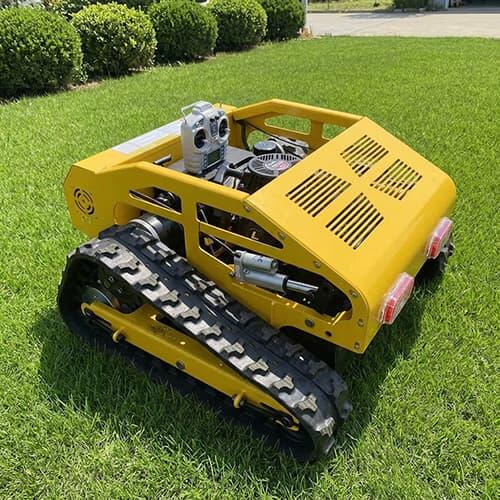
One of the fastest-growing categories in both Europe and North America is the remote control crawler lawn mower. Labor shortages continue to challenge landscaping businesses, making it increasingly difficult to recruit and retain skilled operators.
Remote control mowing technology allows operators to maintain safe distances while controlling machines on steep slopes, roadside embankments, solar farms, orchards, and difficult terrain. This dramatically improves workplace safety while increasing operational efficiency.
Many contractors are actively exploring commercial RC mower solutions through industry platforms such as Alibaba International, where demand for intelligent slope mowing equipment continues to rise.
The latest generation of remote-controlled lawn mowers integrates multiple advanced features, including intelligent obstacle avoidance, an adaptive traction system, automatic safety shutdown, and enhanced remote control stability. These features enable contractors to complete projects more quickly while reducing reliance on labor and minimizing safety risks.
Modern landscaping projects increasingly involve challenging environments such as roadside slopes, hilly residential developments, utility corridors, solar installations, vineyards, and mountain properties. As a result, terrain adaptability has become one of the most important criteria when selecting equipment.
Professional buyers are prioritizing machines equipped with crawler track systems, anti-slip technology, and low-center-of-gravity chassis designs. Unlike traditional wheeled equipment, crawler mowers provide superior traction and stability across wet, rocky, and uneven terrain.
Growing interest in these applications can also be seen across professional product demonstrations and customer case studies shared on channels such asAgricultural Machinery TikTok, where contractors regularly showcase real-world slope mowing projects.
Commercial landscaping companies are increasingly focused on total ownership costs rather than simply initial purchase prices. Equipment that offers long service life, simplified maintenance, and reduced downtime delivers greater profitability over time.
Manufacturers are responding by introducing reinforced steel frames, sealed electrical systems, corrosion-resistant coatings, and industrial-grade components designed for continuous outdoor operation. Buyers now expect equipment to withstand years of exposure to harsh weather conditions while maintaining reliable performance.
Machines that require fewer repairs and simpler maintenance schedules are becoming highly attractive to contractors managing large fleets of equipment.
Another rapidly growing trend is the demand for customized branding solutions. As product performance becomes increasingly standardized across the industry, distributors are seeking ways to differentiate themselves through private-label equipment programs.
Customized branding options such as logo placement, personalized color schemes, multilingual interfaces, and custom packaging enable distributors to establish stronger local brand recognition and increase profit margins.
Many overseas buyers are now working directly with manufacturers through platforms such asMade-in-Chinato develop exclusive product lines tailored to their regional markets.
Cross-border procurement has evolved significantly in recent years. Professional buyers increasingly rely on digital platforms, factory-direct sourcing, online demonstrations, and virtual product evaluations when selecting equipment suppliers.
This shift has accelerated access to advanced technologies while creating stronger competition among manufacturers. Buyers now expect transparent communication, fast technical support, reliable spare parts supply, and direct factory relationships.
For companies seeking additional information about commercial remote control lawn mowers, customized branding programs, or factory-direct cooperation opportunities, many international buyers choose to communicate directly with product specialists such as Cara via WhatsApp at +86 15244567951 for project consultations and technical discussions.
The lawn care equipment market in Europe and North America has clearly entered a new phase of modernization. The transition toward battery-powered technology, remote control lawn mowers, terrain-adaptive crawler systems, and intelligent automation is no longer a future prediction—it is already reshaping how professional landscaping operations are conducted today.
For manufacturers, distributors and contractors, adapting to these trends is crucial for maintaining competitiveness and seizing future growth opportunities. Companies that invest in advanced, efficient and environmentally friendly equipment today will be better positioned to lead the next generation of commercial landscape beautification and vegetation management projects.
Get instant pricing, specs, and shipping details from our team.