
86 13686388557

Date:2026-06-22
Hilly and sloped terrain remains one of the most challenging environments for landscape maintenance. Whether you are a professional contractor, municipal maintenance team, orchard owner, or private landowner, working on steep hills introduces significant safety risks that traditional walk-behind and ride-on mowers simply cannot eliminate.
This is exactly why remote control crawler lawn mowers have become one of the fastest-growing categories in the landscaping industry. By allowing operators to remain safely on flat ground while the machine works on dangerous slopes, RC mowers dramatically reduce the risk of falls, rollovers, and workplace injuries.
However, owning an RC mower does not automatically guarantee safe operation. Even the most advanced machine requires proper planning, terrain assessment, and operational discipline. Contractors who consistently achieve safe and efficient slope mowing results all follow a structured workflow before entering challenging terrain.
As more professional users adopt intelligent mowing equipment, many buyers first explore product demonstrations and real-world operating videos through platforms such as industry field demonstrations and compare commercial-grade equipment specifications from trusted manufacturing sources before investing in a machine suitable for steep-slope applications.
The core principle of hill mowing is simple:
Keep the operator away from danger, keep the machine within its actual working limits, and always prioritize control over speed.
Many accidents occur not because of equipment failure, but because operators exceed safe slope angles, mow wet hillsides immediately after rain, or attempt aggressive maneuvering on unstable terrain.
Before beginning any hillside operation, inspect the entire work area. Professional contractors understand that proper preparation prevents the majority of operational incidents.
First, determine the actual slope angle. Manufacturers often advertise maximum climbing capabilities under ideal laboratory conditions. In reality, wet grass, loose soil, thick vegetation, and uneven terrain can reduce safe operating angles by 20–40%.
For this reason, experienced operators always maintain a safety margin:
Dry terrain: keep at least 5° below the rated maximum
Damp terrain: keep at least 10° below the rated maximum
Muddy slopes: reduce operating angles significantly
Unknown terrain: perform test passes before full operation
Next, physically inspect the hill. Remove rocks, branches, exposed roots, and hidden obstacles that may interfere with traction or damage cutting components.
Many commercial users sourcing equipment through professional mower manufacturers often emphasize that terrain preparation contributes just as much to safety as the machine itself.
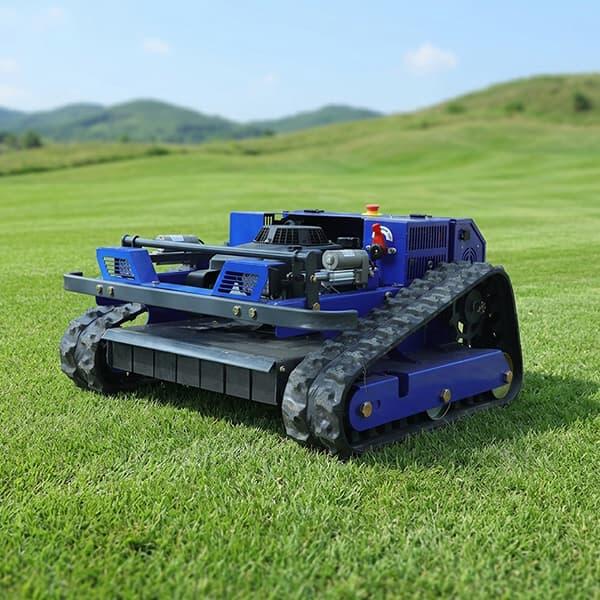
Before entering any slope environment, verify all major systems:
Crawler tracks for wear and proper tension
Blade system for damage and secure mounting
Battery or fuel system for sufficient operating capacity
Remote controller for stable signal transmission
Emergency stop systems for immediate shutdown capability
Signal-loss protection functionality
One overlooked detail among inexperienced operators is remote communication reliability. If the terrain contains dense vegetation, embankments, or blind spots, signal quality should always be tested before mowing begins.
Professional slope maintenance crews rarely rush through hillside projects. Instead, they use controlled movement patterns designed to maximize stability.
The safest method is horizontal contour mowing.
Instead of driving directly up and down steep hills, operators guide the machine across the slope following contour lines. This distributes machine weight more evenly and significantly reduces sliding risks.
Additional recommendations include:
Use low-speed operation on slopes above 25°
Avoid sudden steering corrections
Never accelerate aggressively on inclines
Maintain visual contact with the mower at all times
Perform turning maneuvers only on flatter sections whenever possible
For commercial users unsure which machine configuration best suits their terrain, many choose to consult experienced equipment specialists directly. Technical support teams can often provide project-specific recommendations through WhatsApp at +86 15244567951.
Weather conditions dramatically influence slope safety.
After rainfall, traction levels decrease substantially. Even professional crawler mowers capable of handling 40° dry slopes may require operation at significantly lower angles under wet conditions.
Recommended adjustments include:
Reduce operating speed
Increase overlap between passes
Avoid standing water
Delay operation after heavy rain
Inspect tracks frequently for debris accumulation
When tackling rugged or rocky terrain, operators should focus on smooth, deliberate movements. Excessive speed increases vibration and reduces control, especially on uneven surfaces.
| Safety & Performance Metric | Manual/Ride-On Mowing | RC Crawler Mowing |
|---|---|---|
| Operator Exposure Risk | High | Very Low |
| Rollover Hazard | Significant | Minimal |
| Safe Working Slope | 15°–20° | 35°–40° |
| Terrain Adaptability | Limited | Excellent |
| Long-Term Safety Cost | Higher | Lower |
Q1: Is contour mowing always safer than vertical mowing?
Yes. Contour mowing distributes machine weight more evenly and reduces downhill sliding forces.
Q2: How much should I reduce operating angles after rain?
A minimum reduction of 10° is generally recommended depending on terrain conditions.
Q3: Can I park the mower on a hill during breaks?
No. Always return the machine to level ground before shutting down or leaving it unattended.
Q4: What safety features are essential for hill work?
Low-center-of-gravity chassis, crawler tracks, signal-loss protection, dual emergency stop systems, and tilt monitoring technology.
Q5: Does hill mowing reduce machine lifespan?
Not when performed correctly. Regular maintenance and proper operation help preserve long-term reliability.
Remote control lawn mowers have fundamentally changed how contractors and landowners approach hillside maintenance. When combined with proper planning, operator discipline, and terrain assessment, these machines provide a significantly safer and more efficient alternative to traditional mowing equipment.
The most successful operators understand that hill mowing is not about testing the machine’s limits. It is about consistently operating within safe margins, maximizing productivity, and protecting both equipment and personnel over the long term.
Get instant pricing, specs, and shipping details from our team.