
86 13686388557

Date:2026-10-07
A realistic look at the learning curve, from the first twenty minutes to the hundred‑hour mark
Most people who buy a remote control mower expect to be fully competent on day one. Sales material often makes it sound straightforward: “If you can play a video game, you can run this.” That statement holds partial truth, yet it leaves out critical real‑world context. The controller layout is intuitive, but intuitive controls do not automatically translate to efficiency, hazard awareness and safe operation on steep slopes after just one afternoon of practice. Drawing from conversations with many new fleet operators and our on‑site training observations, below we break down the actual learning‑curve stages, and show what separates basic familiarity from true operating proficiency.
This part lives up to the marketing claim. The basic control scheme — left stick for drive, right stick for steering, throttle adjusting blade speed — clicks quickly for nearly every new user. Within twenty to thirty minutes holding the remote, you can move forward, turn and stop without constantly thinking about each stick’s function. Anyone familiar with game controllers picks up these muscle‑memory patterns even faster.
What you will not yet possess is operational judgement. You cannot anticipate how the machine reacts when a track drops into a rut, how the rear end behaves starting to slide across a sidehill, or how much turning clearance you require at the top of a slope. You know how to drive it, but you cannot yet “read” the machine’s response to changing terrain.
Plan for two to three hours of flat‑ground practice on your very first day. Choose an empty parking lot or level open field. Drive in circles, execute figure‑eight patterns, and practise smooth forward‑reverse transitions. Locate the emergency‑stop button and trigger it intentionally multiple times to build muscle‑memory response. Operators who skip these foundational drills often freeze up with panic the moment something unexpected happens on a hillside.
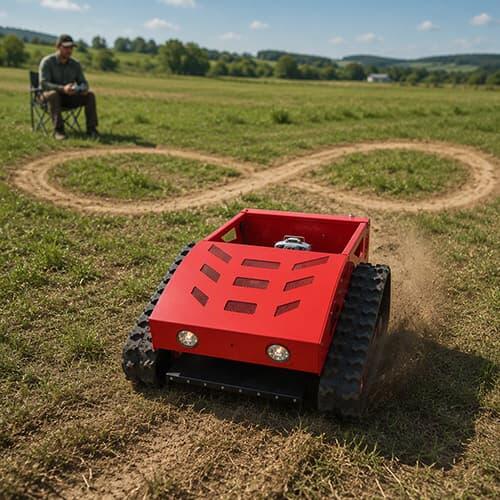
After three‑to‑five practice sessions totalling eight‑to‑twelve operating hours, you can mow regular lawns and flat fields without staring continuously down at the remote transmitter. Your focus shifts toward the machine itself. You start anticipating turns rather than reacting after they happen. New operators quickly discover that full throttle creates jerky movement and wastes fuel or battery power; most settle into 60‑70 % throttle for routine work within their first week.
Slope handling remains your biggest weak spot. Even a gentle 10‑degree incline can feel unsettling when you stand thirty feet away watching an expensive piece of equipment drift sideways. Intellectually you know you are safe, but instinctive unease takes time to fade away.
You will almost certainly bog down the cutting deck at least once: hitting overly thick vegetation, hearing the engine labour, and reacting too slowly to lift deck height or pull back power. Every new operator experiences this; it teaches you to listen for the audible load cues coming from the machine.
At twenty‑to‑thirty hours run‑time, you build up a steady operating rhythm. You become familiar with your own property or recurring job‑site locations. You learn exactly where traction holds and where it fails. You understand how dramatically wet grass alters performance, and you start adjusting work schedules accordingly. You can hold a consistent cutting line on moderate slopes without unwanted drift. Most operators experience at least one heart‑stopping incident such as track slip or near rollback; learning to recover safely from these real‑world events delivers more practical knowledge than any printed manual.
This stage is also when you begin noticing your specific machine’s unique quirks. Perhaps one track lags slightly under heavy load; maybe radio signal drops out in one exact spot due to Wi‑Fi interference; or the nose dips on certain slope angles so you learn to approach from an alternative direction. None of these small behavioural details appear in official documentation — they only reveal themselves through accumulated operating hours.
At fifty‑to‑eighty operating hours, you stop consciously thinking about the joystick inputs. Your hands move instinctively. Your full attention focuses on cut quality, upcoming terrain and planning your next pass. This is where work efficiency sees a major jump. You no longer pause between rows to plan every movement; your operation flows naturally.
Slope work also loses most of its tension. You have experienced minor slips and successful recoveries many times, so you gain clear trust for both machine limits and your own reactions. You instinctively judge when to ease throttle and when you can apply more power. You may also test practices warned against in manuals, and directly learn the real‑world reasoning behind those safety warnings.
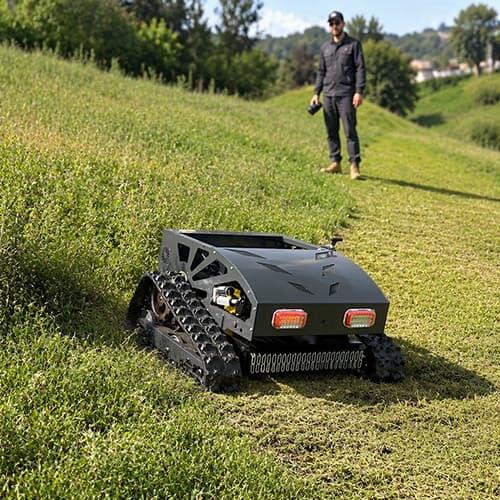
Once you hit one hundred or more hours, you become the go‑to person for less‑experienced peers. You develop personal operating preferences not mentioned in manufacturer materials. You learn that raising deck height for your first pass saves fuel while delivering a cleaner final result. You know exactly which slopes can be driven straight up, and which require zig‑zag travel patterns. Many operators make small practical modifications: reposition antennas, adjust seating arrangements, add sun‑shade accessories.
You begin thinking holistically about the whole working system: machine hardware, operator technique, terrain, weather conditions and job requirements. Maintenance also becomes second nature. You no longer check track tension purely because the manual tells you to; you hear subtle sound changes that indicate misalignment. You automatically clean the undercarriage after finishing work without needing reminders.
Five key factors accelerate or slow your progress:
Prior equipment experience: Skid‑steer, mini‑excavator or zero‑turn mower experience builds spatial awareness and can shave weeks off your learning curve. If this is your first powered machine, add roughly one month to every learning‑curve milestone.
Terrain complexity: Learning on flat half‑acre land differs greatly from working twenty‑acre sites with gullies and steep banks. Challenging terrain builds skill faster yet also creates risk for costly operator mistakes.
Machine responsiveness: Units with proportional controls and fast feedback help you learn quicker. Laggy equipment teaches you bad over‑correction habits that take months to unlearn.
Practice frequency: One hour daily for one week beats four‑hour‑long sessions only on weekends. Short regular practice builds stable muscle memory; infrequent long sessions cause partial skill‑regression between uses.
Mentor observation: Twenty minutes beside an experienced operator can correct multiple bad habits you never notice yourself — this brief guidance can equal ten hours of solo practice. If no mentor is available, record your own work sessions and compare against official demo footage; performance gaps will become obvious.
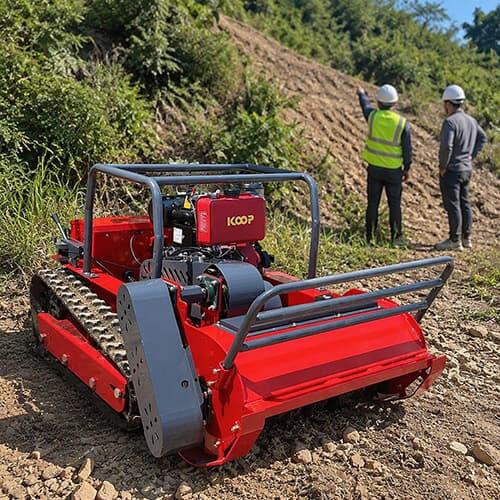
Most operators hit two distinct skill plateaus on their learning journey.
The first plateau occurs roughly week two: you perform adequately on flat ground but stay tense working slopes. The solution lies in gradual incremental exposure. Master 5‑degree slopes first, move to 10°, then 15°. Never tackle your steepest hills until you consistently handle less‑demanding inclines reliably.
The second plateau appears near month two: you can finish jobs acceptably yet stop improving further. Deliberate repetitive drills help you break this barrier. Practise holding perfectly straight cutting lines without staring directly at the machine; practise tight‑radius turning within one machine length; practise backing down slopes — whenever practical avoid travelling forward downhill.
The realistic takeaway: most operators achieve safe, adequate performance for their own property within ten‑to‑fifteen total operating hours. To reach effortless, true professional skill takes approximately eighty‑to‑one‑hundred hours. Even past two hundred hours you will keep picking‑up new practical insights. This is not a flaw of RC mowers. It simply reflects the reality of operating heavy‑duty equipment across real‑world terrain, variable weather and genuine safety consequences.
You can master the machine hardware itself within an afternoon. Mastery of unpredictable ground conditions is what consumes your time. You can watch operator‑training field clips on our TikTok channel. You can also browse different RC mower unit selections on our Made‑in‑China store page.
If you have questions about operator training for your new crew members, reach our engineering team via WhatsApp.
Get instant pricing, specs, and shipping details from our team.