
86 13686388557

Date:2026-10-01
A guide to matching machine class to the place, not the price tag
A large property is not a big garden. It is a collection of different jobs pretending to be one job, and that distinction is where most buyers lose their money. The flat parkland wants width and speed; the lake edge wants low ground pressure; the old orchard wants a deck that will not fold when it meets a hidden stump; the bank behind the wall wants something the operator can stand well clear of. Below is a tier system that treats the property as the sum of those places.
A compact tracked flail with a side-discharge or mulching deck. Width of cut around a metre, radio range of 200 metres, weight kept under two tonnes so a 3.5-tonne trailer can still legally move it. This tier is about the operator not walking the strimmer line for three hours. It will not win a race, but it will finish the property in a day and be home before the light goes.
A proper commercial remote unit, petrol V-twin or diesel, articulated steering, and a deck wide enough to matter — 1.2 to 1.6 metres. At this scale the deck width starts paying for the machine: every extra ten centimetres of cut is an hour off the week. Buy the spare hammer set at the same time. The boundary work is what chews them.
At this size, the choice is no longer only about engine output. Deck width, access between zones, cutting-head durability and the availability of wear parts have a direct effect on how much time the machine spends working rather than being moved or serviced.
Two machines, not one. A wide-area mower for the open ground and a tracked slope machine for the banks, ditches and wood edges. Running one heavy slope machine over two hundred acres of flat parkland is the most expensive mistake made in this category: the deck is too narrow, the ground pressure is wrong, and the tracks wear out on ground they were never meant to wear on.
The two-machine answer costs more up front and is cheaper by year two when the machines are actually matched to their working zones. The wide-area unit can stay productive on open ground while the tracked slope machine is kept for banks, rough boundaries and areas where traction matters more than cutting width.
A semi-autonomous unit with boundary mapping and remote takeover, supported by a smaller RC machine for the bits the map cannot handle. The labour model changes here: one person supervises two or three machines instead of riding one of them.
It only works if the boundaries do not move every season, which is why the same kit often fails on a golf course and succeeds on a solar farm. Repeatable working zones are much easier to manage when the route, obstacles and operating boundaries remain reasonably consistent.
Walk it once with a tape and a notebook, because the salesman is about to sell you acres and you need to buy ground conditions. Note the longest unbroken run of flat grass: that is where width of cut earns its keep.
Note the narrowest gate and the tightest turn: that is where articulated steering either saves you or costs you an extra man. Note the wettest corner and the steepest bank: those are the two places that will decide whether a tracked machine is worth the trailer space.
An hour with a notebook is cheaper than a machine you cannot get through the gate.
Before buying a remote control lawn mower for a large property, it is also worth recording the distance between the storage area and the working zones. A machine that cuts quickly but needs excessive transport between areas can lose much of its practical advantage.
A flail eats everything and leaves a rough finish; a rotary deck leaves a clean lawn and stalls on a thistle the size of your thumb; a mulching deck does neither badly and both adequately.
On a large property you usually want two of the three for different zones, and pretending one deck can do all three is how you end up mowing the same acre twice. The cheapest deck to run is the one that matches the job; the expensive one is the one you apologise for afterwards.
For contractors, estate managers and grounds teams, deck selection should therefore follow the actual vegetation and finish required in each zone. A flail mower suited to rough growth should not automatically be expected to provide the same finish as a dedicated mowing deck.
Twenty minutes of checks before the trailer ramps go down: blades or hammers, tracks, pins, transmitter charge, fuel and oil, and a radio test at the furthest point of the ground.
Then the open ground first while the dew is off and the finish is still clean. Then the edges and banks in the middle of the day when the grass is dry and the machine will not slide. Then a wash-down before the mud sets, because a machine put away dirty is a machine that will not start next Tuesday.
None of this is glamorous. All of it is the difference between a machine that lasts and a machine that becomes a story.
For a commercial RC mower, the daily inspection is also where small problems are normally found before they become expensive failures. Tracks, cutting components, pins, belts and hydraulic or drive components should be checked according to the machine's maintenance requirements.
The purchase price is roughly a third of the five-year cost on a large property. The rest is labour, fuel, wear parts, transport and the occasional recovery.
Hammers, belts and pins are cheap; track replacement and a gearbox repair are not. The machine that looks expensive at the dealer often has the cheaper wear parts and the closer dealer, and that is the maths worth doing before you sign.
For a large-property mower, the purchase decision should therefore include transport, routine servicing, replacement parts and expected downtime rather than looking only at the initial machine price.
For more information about different tracked mower configurations and operating applications, you can view our RC mower field videos.
It is a collection of different jobs pretending to be one job, and that distinction is where most buyers lose their money. The flat parkland wants width and speed; the lake edge wants low ground pressure; the old orchard wants a deck that will not fold when it meets a hidden stump; the bank behind the wall wants something the operator can stand well clear of.
Below is a tier system that treats the property as the sum of those places.
A compact tracked flail with a side-discharge or mulching deck. Width of cut around a metre, radio range of 200 metres, weight kept under two tonnes so a 3.5-tonne trailer can still legally move it.
This tier is about the operator not walking the strimmer line for three hours. It will not win a race, but it will finish the property in a day and be home before the light goes.
A proper commercial remote unit, petrol V-twin or diesel, articulated steering, and a deck wide enough to matter — 1.2 to 1.6 metres.
At this scale the deck width starts paying for the machine: every extra ten centimetres of cut is an hour off the week. Buy the spare hammer set at the same time. The boundary work is what chews them.
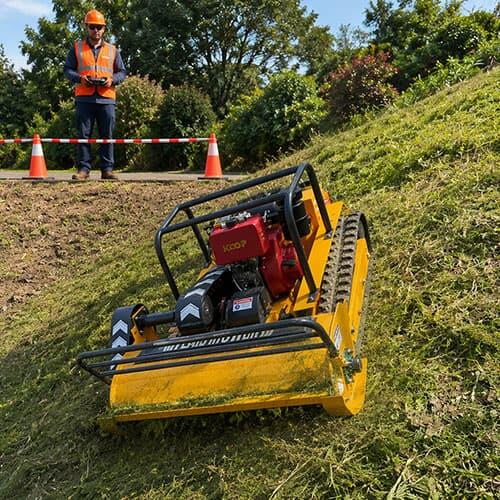
Two machines, not one. A wide-area mower for the open ground and a tracked slope machine for the banks, ditches and wood edges.
Running one heavy slope machine over two hundred acres of flat parkland is the most expensive mistake made in this category: the deck is too narrow, the ground pressure is wrong, and the tracks wear out on ground they were never meant to wear on.
The two-machine answer costs more up front and is cheaper by year two.
A semi-autonomous unit with boundary mapping and remote takeover, supported by a smaller RC machine for the bits the map cannot handle.
The labour model changes here: one person supervises two or three machines instead of riding one of them. It only works if the boundaries do not move every season, which is why the same kit often fails on a golf course and succeeds on a solar farm.
Wet ground calls for wide rubber pads and low ground pressure, not more horsepower. Long grass needs a flail; finish mowing needs a mulching deck, and the two should not share a body.
Public access means quiet electric and a geofence, even if the battery only lasts half a day. Steep banks need a winch point, a second transmitter battery, and an operator who has done it before — none of which are sold in the brochure.
These details are easy to miss when comparing machines by horsepower alone. Ground pressure, cutting system, access, recovery arrangements and operator position can be more relevant to a particular zone than the largest engine available.
Transport is the hidden cost. A machine that needs a tractor and a low-loader every visit will quietly eat the saving.
Servicing distance matters: if the dealer is three counties away, the cheapest machine is the one whose belts and pins your local mechanic can source. And the operator is the specification that survives every trade-in.
A good one with an average machine will out-produce an average one with the best machine on the market.
Before ordering, ask about replacement tracks, belts, hammers or blades, service intervals, transport requirements and normal parts lead times. If the machine will work hundreds of acres each season, these details become part of the operating cost rather than an afterthought.
A 1.2-metre remote flail will handle almost any British estate under fifty acres; above that, accept that you are buying a fleet and plan the trailer and the shed around it.
The mistake is buying one big machine and asking it to be good at everything — it will be adequate at all of it and excellent at none.
If you are comparing machine size, cutting width or different configurations for a large property, you can contact our engineering team on WhatsApp for product and configuration information.
You can also review our remote control mower product range for different tracked mower configurations.
It depends on the working zones rather than acreage alone. The source divides applications into different tiers, from compact tracked flails for smaller mostly flat areas to multi-machine and semi-autonomous arrangements for properties above 200 acres.
No. Wider cutting decks can reduce mowing time on open ground, but narrow gates, tight turns, steep banks and rough boundaries can make a smaller machine more practical for some zones.
A large property can contain very different working conditions. A wide-area mower can handle open ground efficiently, while a tracked slope machine can be reserved for banks, ditches, wood edges and other areas where traction and terrain access matter more.
The source identifies flail decks as suitable for heavier and rougher vegetation, while rotary and mulching decks are better suited to different finish requirements. The deck should match the vegetation and finish expected in each zone.
Measure the longest open run, narrowest gate, tightest turn, wettest area and steepest bank. Then check cutting width, ground pressure, transport requirements, service access, wear parts and the machine's suitability for each working zone.
Transport, labour, fuel, wear parts, servicing and occasional recovery can account for a substantial part of the long-term cost. The purchase price alone does not describe the full operating cost.
Get instant pricing, specs, and shipping details from our team.