
86 13686388557

Date:2026-09-29
A field checklist, written in the order the work actually happens
Safety on a slope is not a feeling and it is not a paragraph in the manual. It is a list of small things done in the right order, most of them before the engine starts. The slope does not care how experienced you are; it only responds to what you actually did on that morning. This is that list, written in the sequence you should work through it.
For a remote control lawn mower, the machine and the operator are separated from each other, but that does not remove the need for disciplined site assessment. Ground conditions, visibility, traction and the machine's rated operating limits still determine whether a slope is suitable for the job.
Measure the slope you will actually work, not the one on the plans. A clinometer or a phone app on the face itself. Plans round corners and grass hides them.
Check the number against the machine's rated angle, then knock ten degrees off it in your head for wet grass, loose stone, and cut material on the ground. The exact operating limit should always come from the machine manufacturer's specification and the conditions at the site.
Walk the face on foot first, every time it has not been cut in weeks. Trip hazards, rabbit holes, old fence wire and scrap metal do not show from the top.
Decide where you will stand, and make sure that place is flat, stable, and above the machine. Never position yourself downhill of the cutting path.
Confirm your line of sight reaches the whole cut. If a hedge, wall, or bend takes the machine out of view, the slope is not yours to mow that day.
Tell someone where you are and when you expect to finish. A slope job with no lookout is a single-point failure dressed up as independence.
For contractors comparing different slope mower configurations, the actual working angle, operator position and visibility should be checked together rather than treating the maximum slope figure as a standalone selling point. You can also see practical RC mower operating examples on our RC mower video channel.
Walk round the machine with the remote in your hand and prove every function: drive both ways, blades engage and disengage, tracks grip on a gentle slope.
Test the loss-of-signal response deliberately. Turn the transmitter off at range and watch what the machine does. If you have never seen it, you do not know it.
Test the physical emergency stop the same way. It must kill the engine without help from the radio.
Check the traction path: tracks, rollers, wheels, belts and guards. A machine that is slipping on the flat will not improve when the ground tilts.
Clear grass and mud from the cooling fins and the deck top. Overheating on a slope turns a ten-minute job into a recovery.
Carry the right kit: spare transmitter batteries, the operator's manual, a fire extinguisher rated for fuel, and something to block the tracks with if you need to stop a roll.
These checks are particularly important for a tracked RC mower because debris, grass and mud can affect the undercarriage, cooling system and cutting deck during the same job. A quick walk-around before starting is much easier than diagnosing a problem halfway down a bank.
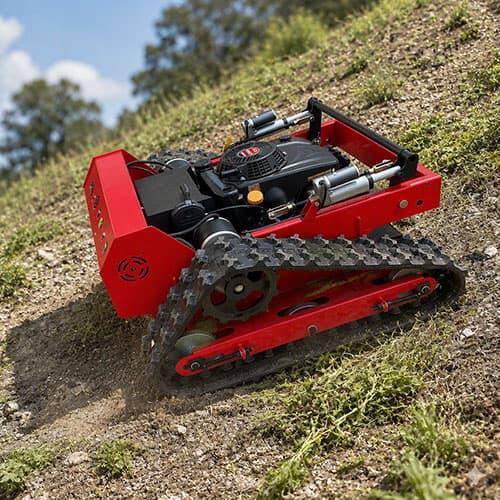
Start on the gentlest strip and cut a single pass end to end. Let the machine teach you what the surface is like today.
Work across the slope, never up and down. The cutting path should follow the contour, so a loss of traction slides you sideways instead of carrying you downhill.
Keep the machine below you, not above you, and keep it in sight. If the angle of the face takes it out of view, move, or stop.
Reduce ground speed before the slope gets steep, not after. Traction lost at speed is not recovered at speed.
Cut high the first time on long or rank growth, then drop the deck for the second pass. A loaded deck is the fastest way to lose drive on a hill.
Never cross a ditch, culvert, or water bar on the angle. Straighten up, cross at the shallow point, and resume the contour on the far side.
Stay off the slope in rain, immediately after, or when frost is out. Wet clay and slick rock are a different surface from yesterday's dry grass.
If the machine starts to slide, release the drive levers immediately. Do not fight it with throttle; you will only dig the leading edge in.
Contour mowing also puts more emphasis on smooth control than simply having a powerful engine. A tracked mower with appropriate ground contact can be easier to control on uneven terrain, but the operator still needs to work within the manufacturer's slope and traction limits.
If it tips, do nothing in a hurry. Secure the site, shut the fuel off if you can reach it safely, and recover with proper rigging rather than a desperate strap.
If it loses signal, stand still and wait. Most systems time out into a stop; approaching a machine that may restart is how operators get hurt.
If it stalls on the face, do not climb down to it. Restart from your standing position and drive it out under its own power.
If it catches fire, let it burn in a safe place. Fuel, oil and a plastic body are not worth reaching over.
If a machine behaves differently from its normal fail-safe response, do not assume the problem will correct itself. Stop the operation and have the control, receiver, emergency-stop and drivetrain systems inspected before continuing.
If you need configuration or operating information for a specific slope mower, you can contact our engineering team on WhatsApp.
Wash grass and mud from under the deck and the tracks while it is still wet. Dried material becomes abrasive overnight.
Note what the slope did to the machine: scuffed paint, a strained belt, a sticky roller. Those notes are the early warning for the next job.
Charge or refuel away from the cut material. A spill on a slope travels further than you think.
Put the transmitter away with fresh batteries in it. Finding a flat pack at the top of a bank is not the time to discover the spares are in the van.
Regular cleaning also gives the operator an opportunity to spot wear before the next job. Pay particular attention to tracks, rollers, cutting components, belts, guards and areas where grass or mud tends to collect.
The whole list fits on two sides of paper, and that is the point. A safe day on a slope is not made of courage or instinct; it is made of having done the dull things first. Do them every time, and the slope stops being a story and becomes another job.
For additional product information and different remote control mower configurations, you can also view our remote control mower product range.
[IMG-01] A clinometer app reading taken on the slope face itself, with the operator standing on the flat verge above. Caption: "Measure the slope you are about to cut, not the one on the drawing."
[IMG-02] Machine working a contour pass with the operator positioned above and to one side on level ground, line of sight unbroken. Caption: "Always below the machine, never below the cutting path."
[IMG-03] End-of-day cleaning: the deck being washed out with the machine on level ground, all grass and mud falling clear of the works. Caption: "What you wash off tonight is what will not be welded on tomorrow."
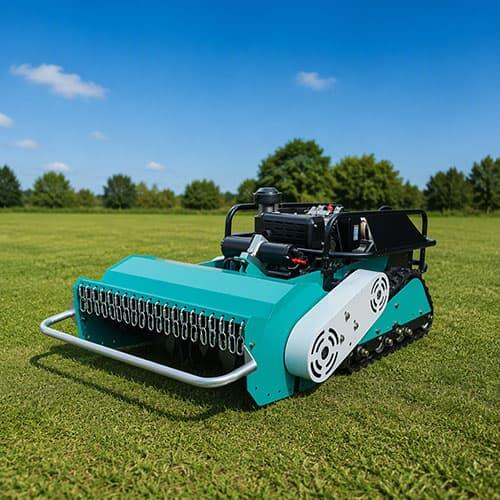
Measure the actual working face rather than relying only on site plans. Then compare the result with the mower's rated operating angle and consider surface conditions such as wet grass, loose stone, mud and cut material.
This article's operating method is to work across the slope along the contour rather than travelling directly up and down the face. The exact operating procedure should also follow the mower manufacturer's instructions.
Stand still and wait for the machine's fail-safe response rather than immediately approaching it. Before normal work, deliberately test the loss-of-signal response so the operator knows exactly what the machine is designed to do.
Keeping the operator on stable, level ground above the working machine provides a better position for maintaining visibility and reduces the need to enter the machine's downhill working path.
Clean grass and mud from the deck and tracks, inspect visible wear or damage, record anything unusual from the job, and prepare the transmitter and machine for the next operation.
Not necessarily. The rated angle is only one part of the operating conditions. Surface type, moisture, loose material, visibility, obstacles, traction and the actual machine configuration also need to be considered.
Get instant pricing, specs, and shipping details from our team.