
86 13686388557

Date:2026-06-25
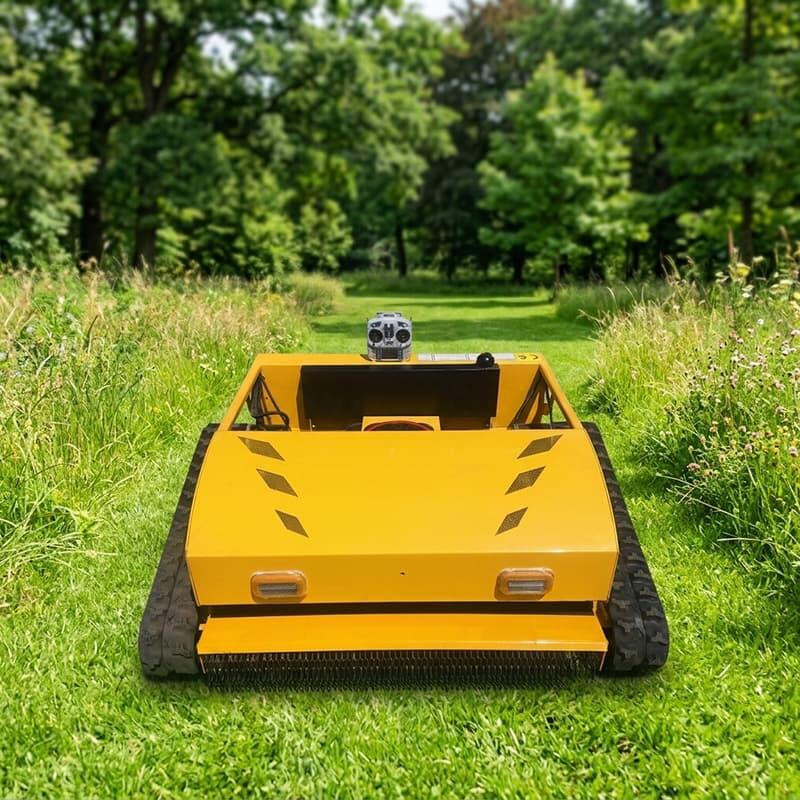
One of the major advantages of a remote control lawn mower is that it can handle steep terrains more safely compared to traditional walking or riding lawn mowers. However, many users eventually encounter a frustrating problem: The lawn mower performs perfectly on flat ground, but when operating on slopes, it may experience skidding, side-slipping, belt spinning, or even sliding down the slope.
For professional landscaping contractors, municipal maintenance departments, orchard owners, and property managers, traction loss is far more than just an inconvenience. Insufficient grip leads to uneven cutting quality, repeated trimming needs, reduced productivity, accelerated track wear, and potential safety hazards. In severe cases, uncontrolled slippage can damage equipment and create hazardous working conditions.
The good news is that most RC mower traction problems are not caused by equipment defects. In reality, they are usually related to terrain conditions, operating habits, machine maintenance, or unrealistic expectations regarding slope limits. Understanding these factors can dramatically improve mower performance and extend equipment lifespan.
Many professional contractors who share mowing demonstrations through platforms such as industry field operation channelsoften emphasize that slope performance depends as much on proper operation as it does on machine specifications.
To understand why slipping occurs, users first need to understand how crawler mower traction actually works.
Three factors determine whether a mower maintains grip on a slope:
Ground friction coefficient
Uniform ground contact pressure
Machine balance and stability
On level ground, gravity pushes the tracks downward evenly, maximizing friction. On slopes, gravity creates both downward pressure and downhill pulling force. Once downhill force exceeds available friction, traction loss begins immediately.
This is why a lawn mower that performs perfectly on flat ground may behave very differently on a slope.
It should also be noted that the manufacturer's slope performance rating is usually measured under controlled testing conditions, which include dry roads, stable soil, and an ideal traction environment. The actual road conditions may reduce the effective slope performance by 20% to 40%.
More than 60% of traction-related issues originate from environmental changes rather than mechanical problems.
Water creates a thin lubricating layer between tracks and the ground. Even commercial-grade anti-slip crawler tracks experience reduced grip when working on wet grass.
Soft soil compounds the problem by decreasing ground support. A mower rated for 40° slopes may only operate safely around 30° when conditions are wet.
Loose surfaces cannot provide the same traction as compact turf. Instead of gripping the ground, tracks often scrape away the top layer of material, creating continuous micro-sliding.
This issue frequently occurs on:
Highway embankments
Mountain trails
Newly landscaped slopes
Solar farm maintenance zones
Healthy turf creates natural friction. Bare ground, heavily worn grass, and extremely short-cut surfaces provide significantly less resistance, reducing overall slope stability.
Even the most advanced commercial mower can lose traction when operated incorrectly.
Many operators instinctively mow directly uphill and downhill. While this may seem efficient, it places maximum stress on the traction system.
Any sudden speed change can instantly upset balance and trigger downhill sliding.
Experienced contractors generally prefer contour mowing patterns that follow the natural shape of the slope.
Speed increases momentum. On steep terrain, momentum works against traction.
High-speed operation often results in:
Track spinning
Side drifting
Reduced steering accuracy
Increased rollover risk
When cutting height is set too low, the mower deck drags against grass and soil. This additional resistance shifts weight distribution and may reduce track contact with the ground.
Maintaining an appropriate cutting height often improves traction significantly.
Traction performance naturally decreases over time if maintenance is neglected.
Track tread patterns gradually become smoother after extended use.
When anti-slip grooves wear down, friction decreases dramatically on steep slopes.
Many commercial users purchasing replacement parts through suppliers listed onprofessional equipment manufacturing platformsoften discover that worn tracks were the primary cause of recurring traction issues.
Uneven track tension creates unequal ground pressure.
If one side is tighter than the other, the mower naturally drifts toward the looser side, especially on hillsides.
Heavy grass accumulation underneath the cutting deck increases resistance.
When power is diverted toward cutting overloaded vegetation, less energy remains available for maintaining traction.
One of the most common mistakes among new buyers is assuming that maximum rated slope equals recommended operating slope.
Professional operators typically reserve a safety margin of at least 5° to 10° below rated capacity.
For example:
Rated 40° slope → Recommended daily operation around 30°–35°
Rated 45° slope → Recommended daily operation around 35°–40°
This safety buffer helps compensate for weather changes, vegetation resistance, and surface inconsistencies.
Avoid mowing immediately after heavy rainfall
Reduce slope limits on wet terrain
Remove loose gravel when possible
Use slower operating speeds on unstable surfaces
Use contour mowing whenever possible
Avoid aggressive steering
Maintain steady speed
Reduce sudden acceleration
Clean mud after every operation
Check track tension weekly
Inspect tread wear
Replace damaged tracks promptly
Never operate continuously at the absolute maximum rated angle.
A small reduction in slope angle dramatically increases stability and extends component life.
| Slipping Phenomenon | Main Cause | Fast Fix |
|---|---|---|
| Track spinning with downhill slide | Wet grass and low friction | Wait for ground to dry and reduce speed |
| Side drift | Uneven tension or uneven terrain | Adjust tracks and mow horizontally |
| Loss of grip uphill | Excessive slope or overload | Reduce slope angle and clean deck |
| Recurring slipping | Track wear | Replace crawler tracks |
| Slip after turning | High-speed steering | Slow down before turning |
This situation is usually caused by environmental factors rather than mechanical failure. Wet grass, excessive slopes, and aggressive steering are more common causes than track defects.
A slight adjustment in position is normal, but continuous orbital rotation and uncontrolled sliding indicate a malfunction in the traction system, and it should be corrected immediately.
No. However, accumulated mud and debris can accelerate wear if not cleaned regularly.
Reduce the vehicle speed, remove the loose materials on the road surface, and maintain a smooth steering operation.
Yes. Continuous slippage will exacerbate wear and tear on the tracks, drive components, and chassis system.
For contractors dealing with steep roadside slopes, solar farms, orchards, and commercial landscape projects, selecting the right crawler mower configuration is critical. Many buyers compare models through ourofficial Alibaba storefrontbefore discussing specific project requirements.
If you need personalized recommendations regarding slope capacity, crawler track options, or commercial fleet purchases, you can directly contactCara on WhatsApp (+86 15244567951)for technical support and equipment guidance.
Remote control mower traction loss is rarely caused by manufacturing defects. In most cases, the root causes include reduced environmental friction, improper operating techniques, component wear, and unrealistic slope expectations.
By understanding the working principles of traction, properly maintaining the tracks, adopting a safer mowing mode, and adhering to practical slope limitations, users can significantly enhance the stability and productivity of lawn mowing.
Whether you are managing municipal road projects, orchard maintenance plans, commercial landscape contracts, or private hillside properties, proper traction management is key to achieving safer operations, cleaner cutting results, and longer equipment lifespan.
Get instant pricing, specs, and shipping details from our team.