
86 13686388557

Date:2026-10-14
Why slopes keep pushing crews away from wheeled units
Walk a steep property with a contractor and you will often see the same equipment decision. The wheeled mower stays on the trailer, while the tracked remote control machine comes off first. That is not simply a preference for newer equipment. It comes down to how the machine behaves when the ground becomes steep, soft, uneven, or difficult to access.
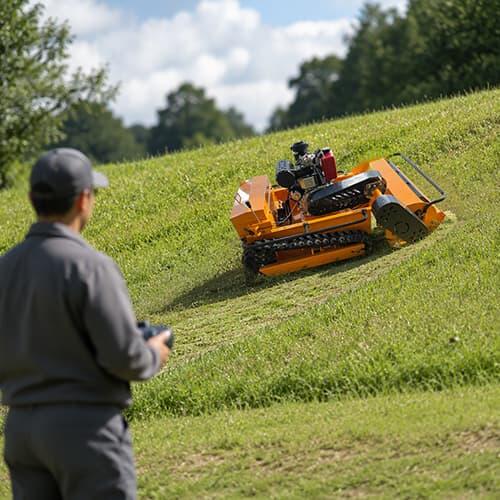
Tracked RC mowers are becoming the preferred choice for steep terrain because they address two practical problems at the same time: keeping the machine planted on the slope and keeping the operator away from the rollover zone. For contractors working embankments, ditch lines and roadside banks, those two factors can have a greater effect on the job than horsepower alone.
A wheel concentrates the machine's load through a relatively small contact area. A track spreads that load over a much broader footprint. The result is lower ground pressure and better support when the soil is soft or the bank is easily damaged. On a sidehill, the longer contact area also gives the undercarriage more continuous contact with the surface, helping the machine maintain its line instead of gradually drifting sideways with each pass.
That difference becomes more noticeable when the ground is uneven. A wheeled machine has to continuously respond to changes in the slope and surface. A tracked machine distributes its weight along the track and gives the operator more control over the machine's position. The track itself does not make a slope harmless, but it gives the platform characteristics that are better suited to this type of work.
Then there is the operator. On a steep slope, one of the major risks of a traditional ride-on mower is having a person sitting directly on the machine. A rollover can turn a routine maintenance job into an emergency within seconds. With a remote control mower, the operator can remain on more suitable ground and monitor the machine from a distance rather than sitting on the slope itself.
For crews working embankments, ditch lines and roadside banks repeatedly, moving the operator away from the machine can be a major operational advantage. The actual working distance should still be determined by the machine's remote-control range, visibility, site conditions and operating instructions.
None of this means tracked machines are better everywhere. They are not. On flat, open ground, a wheeled mower can be faster, less expensive to purchase, and considerably cheaper to maintain. Tracks wear, they collect debris, and replacing a worn track is a real operating cost.
If a property is mostly gentle pasture with only one short bank, a good wheeled mower can still be the more rational choice. The move toward a tracked platform makes more sense when steep terrain is not an occasional obstacle but a regular part of the job.
The vegetation matters as well. Thick brush, bramble and knee-high weeds on a slope are where a tracked flail machine can show a clear practical advantage. A finishing mower is not intended for this type of material, while a wheeled machine may struggle to maintain its position long enough to make a consistent pass.
On steep terrain, the cutting system and undercarriage have to work as one system. A capable deck cannot compensate for a platform that cannot maintain traction. For this reason, when selecting a remote control lawn mower for slopes, the deck, track system, machine weight, center of gravity and rated working conditions should be considered together rather than looking at engine power alone.
Wet grass is where the difference between wheeled and tracked machines can become particularly obvious. A wheeled mower that climbs a dry face without difficulty may start sliding after rain. The tire contact area becomes less effective, tread can fill with wet material, and the machine may begin to drift across the slope.
A tracked unit also loses traction in wet conditions. Tracks do not eliminate the effect of mud, saturated soil or wet vegetation. However, the larger contact area can give the machine more usable margin on the same surface. That additional margin is one reason tracked platforms are often considered for slope work in areas where wet conditions are common.
The trade-off is maintenance. Track tension needs to be checked regularly, debris should be removed from the undercarriage after wet work, and the lugs need to be inspected for wear. These are not cosmetic checks. A worn or poorly maintained track can give away much of the traction advantage that justified choosing a tracked mower in the first place.
For contractors using an RC mower regularly, track condition should therefore become part of the daily inspection routine. Cleaning the undercarriage, checking tension and replacing worn components before they become a field failure is usually much cheaper than dealing with a machine that loses its working ability halfway down a slope.
The practical difference is often easier to understand after a season of work than during a showroom demonstration. Operators notice that they spend less time bracing themselves against a tipping seat because they are no longer sitting directly on the slope. The working position becomes less physically demanding, particularly when the same type of embankment has to be maintained repeatedly.
They can also notice fewer passes on difficult ground. When a tracked machine maintains its position more consistently, the cutting line can stay straighter and the finished area can become more uniform. Better machine control can also reduce unnecessary scraping of banks and accidental contact with fences, guardrails and other obstacles.
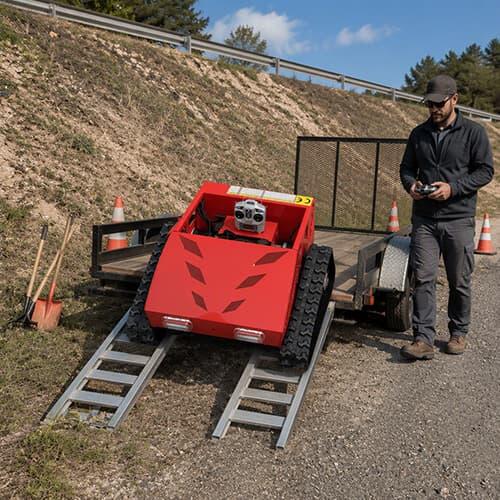
There is, however, a cost that should not be ignored: transport. A tracked mower is not designed to travel between sites at road speed. Moving between several locations can take longer, and loading and unloading require more care. If a contractor has ten short jobs spread across a large service area, that travel time can become significant.
The economics of a tracked RC mower therefore depend on where the machine spends its working hours. The tracked platform earns its advantage on steep and difficult ground, not during the road travel between jobs.
For examples of tracked remote-control mowing applications and machine operation, you can also review our RC mower videos on TikTok.
Do not shop by horsepower alone. On steep ground, the more useful starting point is the machine's sustained grade rating. Treat that rating as an operating reference rather than a guarantee for every surface condition. A grade figure measured on dry, firm ground does not automatically describe performance on wet grass, loose soil or a muddy sidehill.
Ask what the machine does on wet grass. Ask what happens when one track loses drive. Ask how the machine behaves if the remote signal is interrupted. The machine should have a defined fail-safe response and should stop rather than continue moving toward the edge. These questions tell you considerably more about a slope mower than a large horsepower number printed on a specification sheet.
Then look at the practical details: deck width relative to your gates and access routes, cutting height, machine weight, track construction, service requirements and the availability of common replacement parts such as belts and rollers. For commercial users, parts supply can become just as important as the original purchase price because a machine waiting for a small component is not earning money.
A few hours on the machine can tell you more than a brochure. If possible, test it on the steepest section of your actual working area and, ideally, under damp conditions. That is where the difference between a machine that looks suitable on paper and one that actually fits the job becomes much easier to see.
When comparing models, you can also view our RC mower product range on Made-in-China and compare the machine configuration with your slope, vegetation and access conditions.
Tracked RC mowers are not becoming popular on steep terrain simply because they are newer machines. Their position comes from how the platform behaves when the ground becomes difficult. Tracks provide a larger working footprint, while remote control allows the operator to work away from the machine instead of sitting directly in the rollover zone.
That does not make a steep slope automatically safe. The machine still has to be operated within its rated conditions, with attention to ground moisture, surface stability, visibility, remote-control operation and site-specific safety requirements. A tracked machine is a tool for reducing the limitations of steep-terrain work, not a substitute for proper operating procedures.
Tracked machines are also slower on the road, more expensive to maintain and unnecessary for many flat properties. Those disadvantages become easier to justify when steep terrain represents a major part of the contractor's actual workload.
If the slope is the job, tracks are often the platform worth considering first. For machine configuration, slope conditions and working requirements, you can contact our engineering and sales team through WhatsApp.
No. The right platform depends on slope, surface condition, vegetation, access and the machine's rated operating range. Tracks are particularly useful when steep terrain is a regular part of the job rather than an occasional section.
No. Wet grass, mud and loose soil can reduce traction for any machine. A tracked undercarriage can provide a larger contact area, but the operator still needs to work within the machine's rated conditions and adjust operation to the actual ground.
Start with the sustained grade rating, then ask about wet-ground performance, track drive behavior, remote-control fail-safe operation, deck width, cutting height, machine weight and replacement-part availability.
It can be, but it may not be the most economical choice. On large flat and open areas, a wheeled mower can offer lower purchase and maintenance costs and may complete the work faster.
The deck determines what vegetation the machine can actually process. A tracked undercarriage provides the platform and traction, but the cutting system still needs to match the brush, weeds and grass found on the site.
Yes, whenever practical. A demonstration on the steepest part of the working site, especially under damp conditions, can reveal traction, steering, remote-control response, deck performance and access limitations that are difficult to judge from specifications alone.
Get instant pricing, specs, and shipping details from our team.