
86 13686388557

Date:2026-10-12
The spec sheet is not a lie. It is just the cheerful half of the story.
I am not accusing anyone of dishonesty. Manufacturers are selling machines, and a brochure naturally shows the machine on its best day. The problem comes from the gap between that best day and your average Tuesday.
On a real job, the ground may be wet, the grass may be long, the tracks may already have hours on them, and the machine may have to travel through a narrow gate before it reaches the slope. Those details rarely appear next to the horsepower figure or maximum slope number.
That is where buyers usually get surprised. Before you compare prices, engine output or cutting width, these are the questions worth asking about a remote control lawn mower.
Every brochure will give you a maximum slope rating. You may see a machine described as capable of thirty degrees, for example. What the headline number does not show is the exact combination of surface, traction, machine condition, attachment, load, weather and operating direction behind that rating.
A maximum rating should be treated as a ceiling, not as a normal target for daily mowing. On a real site, wet grass, loose soil, worn track lugs, cross-slope movement and changing ground conditions can make the same angle behave very differently.
For that reason, do not make a buying decision simply because the advertised slope number is higher than the slope on your property. Ask the manufacturer what operating conditions were used for the rating and what working range they recommend for repeated operation.
Measure your own slope as well. A clinometer or suitable digital inclinometer gives you something much more useful than estimating the angle from the bottom of a hill.
The practical question is not "what is the maximum angle this machine can survive?" It is "what slope can this machine work on repeatedly under the conditions I actually have?"
[IMG-01] A tracked RC mower sitting at the bottom of a slope after sliding, with a clinometer reading 24 degrees in the foreground and the “30° capable” decal visible on the machine. Caption: “Thirty degrees on the decal. Eighteen degrees on a wet Tuesday.”
Nobody puts this beside the headline specification. A machine that performs well on a dry twenty-five-degree slope may behave very differently when the grass is covered with dew or the soil underneath has become soft.
The contact between the track and the ground is what matters. When the surface becomes slick, the machine can lose traction long before the engine runs out of power.
This is where buyers sometimes blame the machine or immediately assume that new tracks will solve the problem. Sometimes they will help, but sometimes the practical answer is simply to wait for the surface to dry.
If your property is regularly wet, do not build the purchase decision around the published maximum slope figure alone. Ask the supplier how the machine performs on wet grass, what track configuration is available, and what operating conditions they recommend.
For steep-slope work, weather and surface conditions should be treated as part of the machine specification, even though they are not printed on the nameplate.
The sixty- or ninety-minute figure in an advertisement is not necessarily the working time you will see on your property. Runtime depends heavily on load, vegetation, slope, travel speed, cutting conditions and battery condition.
Short grass on relatively flat ground is an easy test. Tall ragweed, thick brush and continuous slope work demand more from the drive and cutting systems and can reduce usable runtime considerably.
That means battery capacity should be evaluated against the actual job rather than the number printed in the brochure. Ask the supplier what runtime was measured under, how much of the test involved cutting rather than travelling, and whether the stated figure assumes flat or light-duty operation.
Charging time matters too. If you purchase only one battery pack, your working day is limited by that battery and the available charging time. Commercial operators who need continuous operation may therefore prefer a second battery pack or a charging arrangement that matches the working schedule.
Before comparing a battery-powered RC mower with another model, calculate the actual mowing cycle: working time, charging time, transport between areas and expected breaks. That gives you a much more useful number than advertised runtime alone.
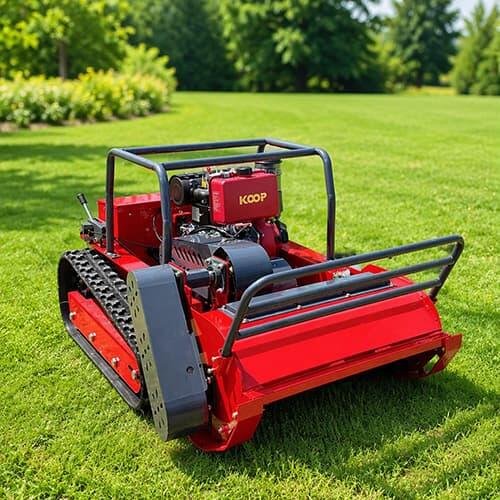
This is one of the costs buyers notice only after the machine has been working for a while.
Rubber tracks operating on rocky or abrasive ground will wear. The speed of that wear depends on the surface, track design, tension, operating method and working hours. A machine used regularly on rough terrain can consume tracks much faster than one working on clean grass.
The same applies to blades or flail hammers. They hit vegetation, stones and other material that a conventional lawn tractor may never encounter. Sharpening and replacement are therefore part of normal ownership rather than an unusual repair.
When comparing machines, ask for the price and expected service interval of the main wear components. Track replacement, blades or hammers, belts, pins and other consumables should be included in your operating-cost calculation from the beginning.
For a commercial tracked mower, the cheapest machine to buy is not automatically the cheapest machine to operate. Wear-part availability and cost can make a significant difference over several seasons.
[IMG-02] A worn rubber track pulled off a machine, lugs visibly flattened, placed next to a new track with full lug depth, with a price tag from the dealer visible in the background. Caption: “This wears out. Plan for it like you plan for fuel.”
If your machine is imported and a drive motor fails, you may be looking at an international shipping wait rather than a Saturday trip to a local dealer.
This is one of the questions I would ask before placing an order, especially for a machine that will be working commercially. Ask for the normal lead time and supply arrangement for the three components most likely to stop the machine: drive motor, remote control and hydraulic pump.
Do not accept only a general answer such as "parts are available." Ask where the parts are stocked, how they are shipped, and what the normal lead time is.
A machine earning money cannot afford unnecessary downtime. Some commercial operators also keep a spare remote control or other critical components available because a relatively small spare can prevent a complete work stoppage.
This is also where an experienced export supplier should be able to explain the practical after-sales process rather than simply showing a parts catalogue.
[IMG-03] A workbench with a failed remote control unit and a handwritten note reading “ordered 14 days ago”, alongside the idle mower it belongs to. Caption: “The machine is fine. The remote is in another country.”
Before purchasing, you can also review our RC mower field videos to see different machines and working conditions in practical applications.
A warranty does not mean every component and every type of damage is automatically covered.
Tracks, blades, sprockets, remote batteries, hydraulic fluid, normal wear and accidental damage are commonly treated differently from engine or major-component failures. The exact exclusions depend on the supplier and warranty terms, so this is one area where you should read the actual warranty document rather than rely on a sales conversation.
Maintenance records can also matter. Keep receipts for service work, record operating hours and follow the required maintenance schedule. If a claim is made later, written maintenance records are much more useful than a verbal promise.
Ask these questions before buying:
Which components are covered?
Which wear parts are excluded?
What happens if a component fails during the warranty period?
Who pays the shipping cost for replacement parts?
Where is warranty service handled?
A good supplier should be comfortable answering these questions before you place the order.
Online video can make machinery look deceptively compact. In person, a commercial RC mower is a serious piece of equipment, and getting it to the job can be a different problem from operating it once it arrives.
Measure the gate before buying. Measure the trailer or loading platform. Check the ramp angle and the turning space at the bottom and top of the slope.
Also consider where the machine will be stored and how it will be washed and maintained. A machine that works perfectly on the grass but cannot be moved through your normal access route is not a practical machine for that property.
Transport should therefore be part of the specification review. Ask for the machine's actual operating weight and dimensions rather than estimating them from a video.
Before ordering, it is worth checking the remote control mower product range together with the machine dimensions and configuration you require.
Nobody wants to talk about signal drop when everything is working normally. You should ask about it anyway.
If the signal is lost, what exactly does the machine do? Does the cutting deck stop? Do the tracks stop? Does the machine hold its position, coast or enter another failsafe mode?
The answer should be specific to the actual control system on the machine you are buying. Do not accept a vague statement that the machine simply has "signal protection."
Test the failsafe on flat ground before taking the machine onto a slope. Deliberately interrupt the connection according to the manufacturer's recommended test procedure and observe the response yourself.
Interference can also be relevant. Wi-Fi equipment, power lines, other radio systems and site-specific obstacles may affect communication. A professional operator should know the expected control range and understand how the machine behaves if communication is interrupted.
On a slope, predictable failsafe behaviour matters far more than an impressive maximum control distance printed in a brochure.
For a machine intended for commercial slope mowing, you can contact our engineering team on WhatsApp to discuss machine configuration, operating conditions and product information.
The undercarriage collects mud and grass, particularly after wet work. If that material is allowed to build up, it can affect rollers, tracks and ground contact and make normal maintenance much harder.
Cleaning is therefore not an optional cosmetic job. For a tracked slope mower working in wet or muddy conditions, it should be part of the daily routine.
After a wet shift, allow time to clean the undercarriage and cutting deck according to the manufacturer's maintenance instructions. Check the tracks, rollers and other areas where grass or mud can accumulate.
Storage matters too. You need a suitable place to wash the machine, inspect it and let it dry before the next job. A pressure washer may be useful, but it should be used according to the manufacturer's recommendations around bearings, electrical connectors, seals and other sensitive components.
Good cleaning practice does more than make the machine look better. It makes wear easier to see and gives the operator an opportunity to identify loose fasteners, damaged track components, leaks or other problems before the next working day.
None of these points is a reason not to buy an RC mower. In the right application, a remote control lawn mower is genuinely useful for steep, dangerous, rough or difficult-to-access ground.
The point is to understand what you are actually buying.
Before the money leaves your account, ask the dealer these nine questions:
What is the recommended working slope under normal conditions, not just the maximum rating?
How does wet grass affect traction and recommended operation?
What runtime should I expect under my actual cutting conditions?
What are the normal wear intervals and prices for tracks, blades or hammers?
Where are the main spare parts stocked and what are the normal lead times?
Exactly what is covered and excluded by the warranty?
What are the machine's actual dimensions and operating weight?
What happens if the remote-control signal is lost?
What cleaning and daily maintenance does the machine require?
A supplier that answers these questions clearly is giving you information you can actually use. A supplier that only repeats the horsepower, maximum slope and cutting width has not told you enough yet.
The best buying decision is not necessarily the machine with the biggest engine or highest advertised slope rating. It is the machine whose operating limits, maintenance requirements, parts support and transport requirements fit the work you actually have.
Start with the actual terrain and working conditions. Check slope angle, wet-ground conditions, expected runtime, machine dimensions, transport access, wear-part costs, spare-parts availability, warranty terms, failsafe behaviour and daily maintenance requirements.
No. A maximum rating should not automatically be treated as the normal working angle. Actual performance depends on surface conditions, traction, machine configuration, vegetation, weather and other site factors. Always follow the manufacturer's operating limits.
There is no single runtime that applies to every job. Flat ground and light vegetation normally place less demand on the machine than steep slopes, tall grass and heavy cutting. Ask the supplier what conditions were used to obtain the advertised runtime.
They are normal wear items and should be included in the ownership budget. The actual replacement interval and cost depend on the machine, working surface, operating hours and cutting conditions.
Very important for commercial users. A machine that cannot work because a relatively small component is waiting for international shipping can create more cost than the part itself. Ask where critical parts are stocked and what the normal lead time is before purchasing.
The exact response depends on the machine's control and failsafe system. Ask the supplier for the specific behaviour of the model you are buying and test the failsafe on flat ground before operating on a slope.
For machines working in wet grass, mud or rough vegetation, cleaning should be part of the normal maintenance routine. Removing accumulated material from the undercarriage and cutting system also makes it easier to identify wear, damage or leaks.
Get instant pricing, specs, and shipping details from our team.